



What to look for in an engineering software asset management (ESAM) solution
At a 5,000-person organization, the license administration playbook usually already exists: named-user seats reconciled against install counts, renewals tracked in a spreadsheet or a SAM platform, compliance audits handled without much drama. Then someone asks why three engineers were denied Petrel access on the same afternoon a license utilization report said the pool was half-empty, and the existing playbook has no answer – because engineering and specialty applications don’t behave like the rest of the software estate.
Engineering software asset management is a narrower, harder problem than general SAM. The applications are licensed by feature rather than by product – a single commercial title can hide dozens of separately licensed modules – and they run as floating, concurrent pools shared across a team rather than assigned to one named person. A checkout tells you a seat left the pool. It says nothing about whether the seat was doing anything. Four things separate a platform built for this from a general-purpose license tracker bolted onto it:
Depth of metering. Checkout and denial data, straight from the license server, is table stakes – every tool in this category has it. The gap between vendors shows up one layer down: does the platform measure whether a checked-out session was active – keyboard, mouse, CPU, I/O – or does it stop at “checked out”? That distinction is what separates “we need more licenses” from “we need to fix how the ones we have are being held.”
Breadth of analysis. An estate this size rarely runs one license manager. FlexLM, RLM, DSLS, Sentinel, IBM LUM, and a long tail of vendor-specific managers all show up in a real engineering portfolio, often on the same day. Breadth means how many of those a platform reads natively, how many it can be configured against, and – just as important – whether it says so plainly rather than implying blanket coverage.
Delivery. A platform is only as useful as what happens after the purchase order. Look for a defined rollout – a dedicated point of contact, a technical integration phase that doesn’t require your team to become experts in the tool overnight, and role-based knowledge transfer that starts during implementation rather than being left for a self-service portal. The strongest vendors in this category treat go-live as the start of the relationship, not the end of the sale.
Support. Ongoing access to people who know the product, not just a ticket queue – dashboard and report development that doesn’t require your team to learn a BI tool from scratch, and a structured way to revisit usage data ahead of a renewal rather than starting that analysis cold.
With those four criteria in mind, Open iT’s LicenseAnalyzer™ and CLIMS™ are built specifically around answering all four. Here’s how it and four more platforms in this category compare.
iT öffnen
Open iT – through LicenseAnalyzer™ and CLIMS™ – structures its entire product around the depth-of-metering question, naming the layers Level 1, Level 2, and Level 3.
Depth of metering. Level 1 reads checkouts, denials, and concurrency straight from the license server logs, polling hourly at five-minute samples, with Denial Reports, Elapsed Time Reports, and Lingering License Detection for sessions left open after the work stops. Level 2, True Active Usage, measures actual usage: keyboard, mouse, CPU, and I/O activity on the host machine, correlated against the checkout through the Work Ratio Report – the number that separates a genuine capacity shortage from a few people holding licenses open. Level 3, automated reclamation, acts on that idle time directly through four action methods (log, standby, suspend, terminate) across four rule-priority levels, currently on FlexLM, LM-X, LUM, and RLM. For Petrel and ANSYS Workbench, a reclaimed session takes five to fifteen minutes to reopen – the real cost of getting reclamation timing wrong.
Breadth of analysis. As of 15 July 2026, Open iT publishes support for more than 90 license managers, including Sentinel, FlexNet/FlexLM, RLM, DSLS, LM-X, IBM LUM, AltairLM, MathLM, and OLicense. CLIMS™ adds one-console administration – start/stop, options files, expiration monitoring – across 12 of those license manager types, including Petroleum Experts and tNavigator. For applications without a native integration, the Generic License Utility reads command-line output and the Generic Log Parser reads custom log formats – configuration, not a claimed integration. Feature-to-feature-set mapping, maintained centrally, keeps reporting accurate when a vendor reshuffles a bundle – the specific gap that breaks a “product installed” view of software like Petrel or CATIA.
Delivery. Open iT’s published rollout runs five phases.
- Kickoff and planning – a dedicated project manager and a tailored implementation roadmap.
- Technical setup and integration – server deployment and Active Directory integration, run with the customer’s IT team.
- Role-based training – Admin, Analysis, and Reporting tracks, delivered virtually or on-site, starting during implementation rather than after.
- Optimization and use-case development – turning the data into usage analysis and cost-saving reports.
- Ongoing support and partnership – a dedicated support contact and quarterly optimization reviews backed by an SLA.
Support. Beyond the delivery phases, Open iT’s own report and dashboard development team builds or customizes the specific view a customer needs – connecting natively to Excel, Power BI, Tableau, and SSRS – rather than handing over a generic template.
Proof. Devon Energy cut its subsurface software budget 20 percent using Level 1 data across a mixed Flexera and non-Flexera estate of 11 vendors and modules. At Mitta Oy, correcting a faulty license server’s inflated demand count dropped Autodesk usage by as much as 50 percent, saving an estimated €30,000–€40,000 a year. On Gartner Peer Insights, Open iT holds 4.4 out of 5 across 77 verified reviews.
Best for: organizations in energy and subsurface, automotive, semiconductor and EDA, and engineering, manufacturing, and AEC that need real visibility into how their engineering and specialty applications are being used, not just what’s installed, so that data can drive every day-to-day software asset management decision: right-sizing a pool, building a renewal case, answering an audit, or settling a chargeback dispute with a number instead of a guess.
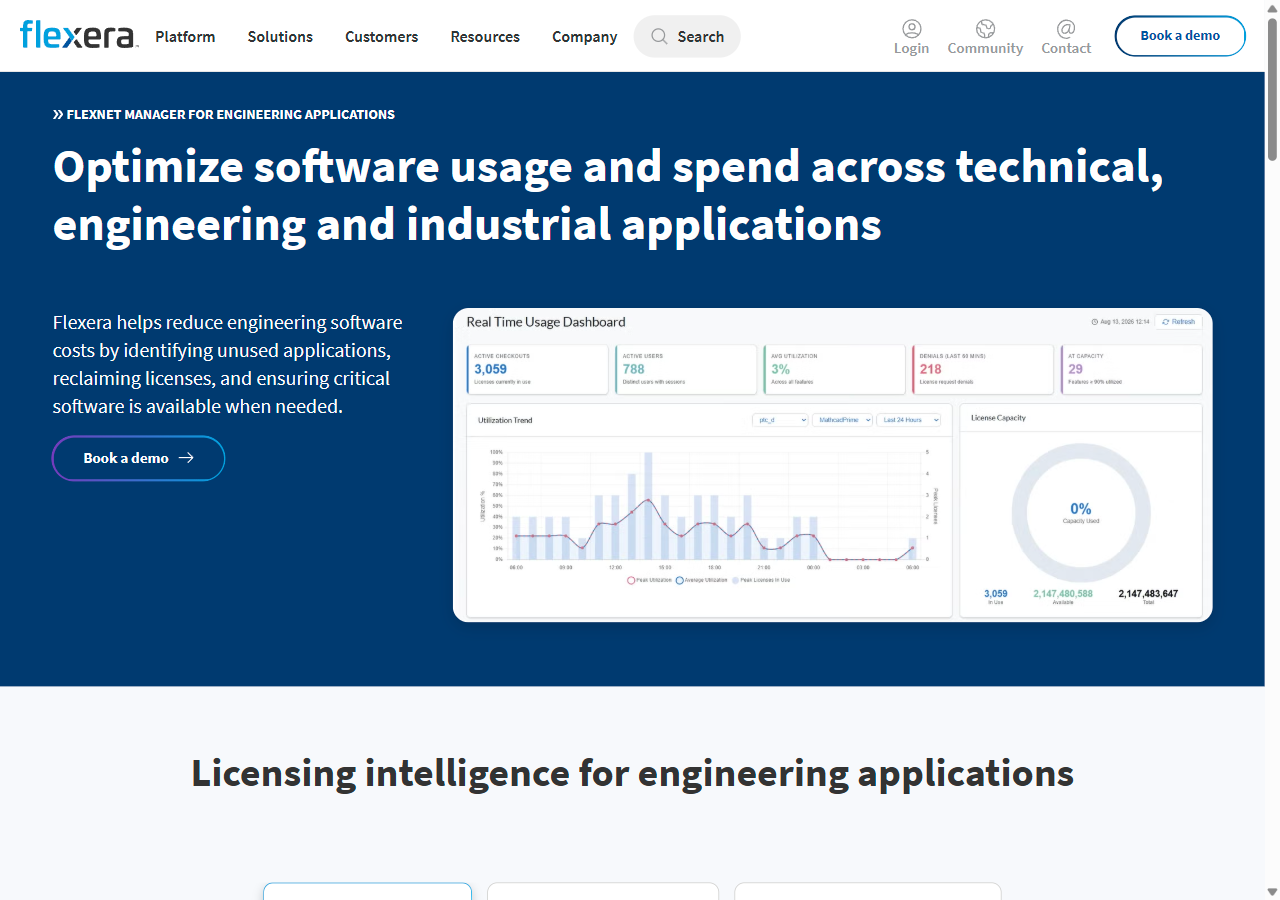
FlexNet Manager for Engineering Applications (Flexera)
FNMEA is Flexera’s purpose-built module for engineering license management, covering CAD, EDA, GIS, Exploration & Production, and PLM categories across manufacturing, engineering, energy, technology, finance, and government customers. Its primary support is FlexLM, with Reprise (RLM) and Sentinel onboardable through a standalone configurator. LM-X and BetaLM are on its stated roadmap rather than supported today. It’s one of the few tools in this category that documents tiered and token-based license model reporting – Autodesk’s multiflex tiers and IBM/Cadence token consumption among them – which matters for estates carrying those licensing models.
On the reporting side, FNMEA runs on IBM Cognos Analytics, with “classic report configurations” that can be exported and imported across environments, alert monitoring, and “held license” notifications that flag a license retained without active use so an administrator can act on it. Real-time dashboards cover current and peak usage and license-server or vendor-daemon health, and chargeback reporting can be split by business unit.
That feature list is worth weighing against reviewer experience: on G2’s 2026-dated reviews page, FNMEA holds roughly 77 reviews at a 4.1-out-of-5 average, and a recurring theme is that the Cognos-based reporting layer adds a BI-skill dependency most licensing teams don’t have in-house – a real cost if your team doesn’t run Cognos elsewhere.
Best for: organizations already standardized on Flexera’s broader FlexNet Manager Suite for IT asset management, who want engineering license data inside the same platform, and estates with meaningful tiered or token-based licensing (Autodesk multiflex, Cadence/IBM tokens) that FNMEA documents by name.
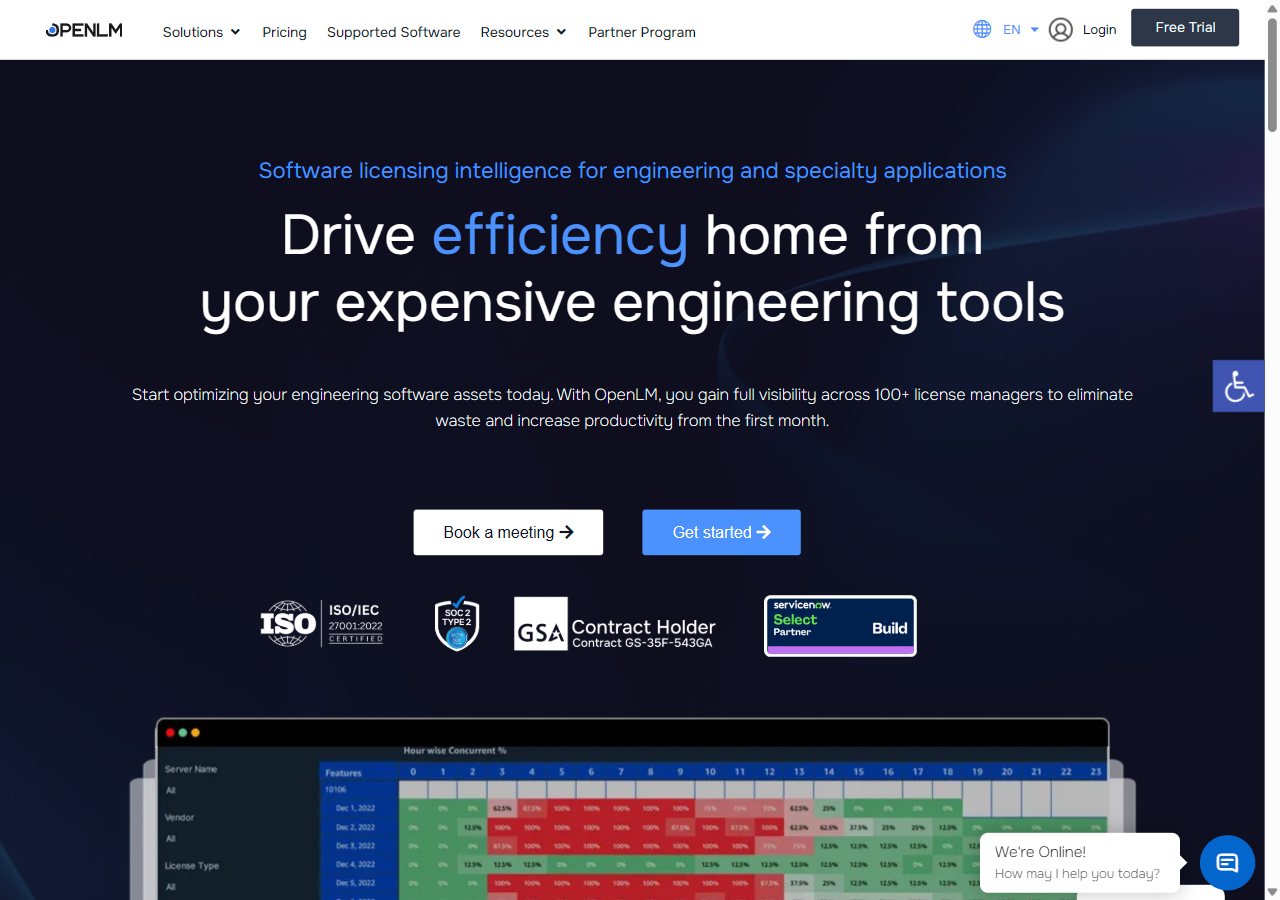
OpenLM
OpenLM positions itself as “software licensing intelligence for engineering and specialty applications,” naming Autodesk, Bentley, Sentinel, Siemens, Dassault Systèmes, Altair, IBM, Hexagon, and Ansys among the vendors it covers, and states support for more than 100 license managers and 25,000-plus engineering applications on its own site.
The platform is organized into named components: the core OpenLM platform with an Analytics module for reporting, a Dongle Monitoring module for hardware-key licenses, and an LDAP connector for directory integration. Named features include License Harvesting for reclaiming idle seats, License Access Control, an Audit System, a Compliance module, Directory Sync, Process Monitoring, and a Reporting Hub, plus a Subscription Optimizer aimed at the SaaS-adjacent side of a mixed estate. It also offers offline usage capture for remote workers and denial tracking with cost allocation.
Where OpenLM stands out from the rest of this list is third-party integration breadth: it names integrations with ServiceNow, Monday.com, and Salesforce, beyond the reporting connections most of this category offers. OpenLM reports an average 25 percent reduction in software license costs across its case studies – a vendor-reported figure, not an independently audited one, and worth asking for the underlying methodology before treating it as a benchmark for your own estate.
Best for: organizations that want the widest self-claimed license-manager and application count in this category, and teams that specifically want license data flowing into ServiceNow, Monday.com, or Salesforce as part of the evaluation, not just Excel and BI tools.
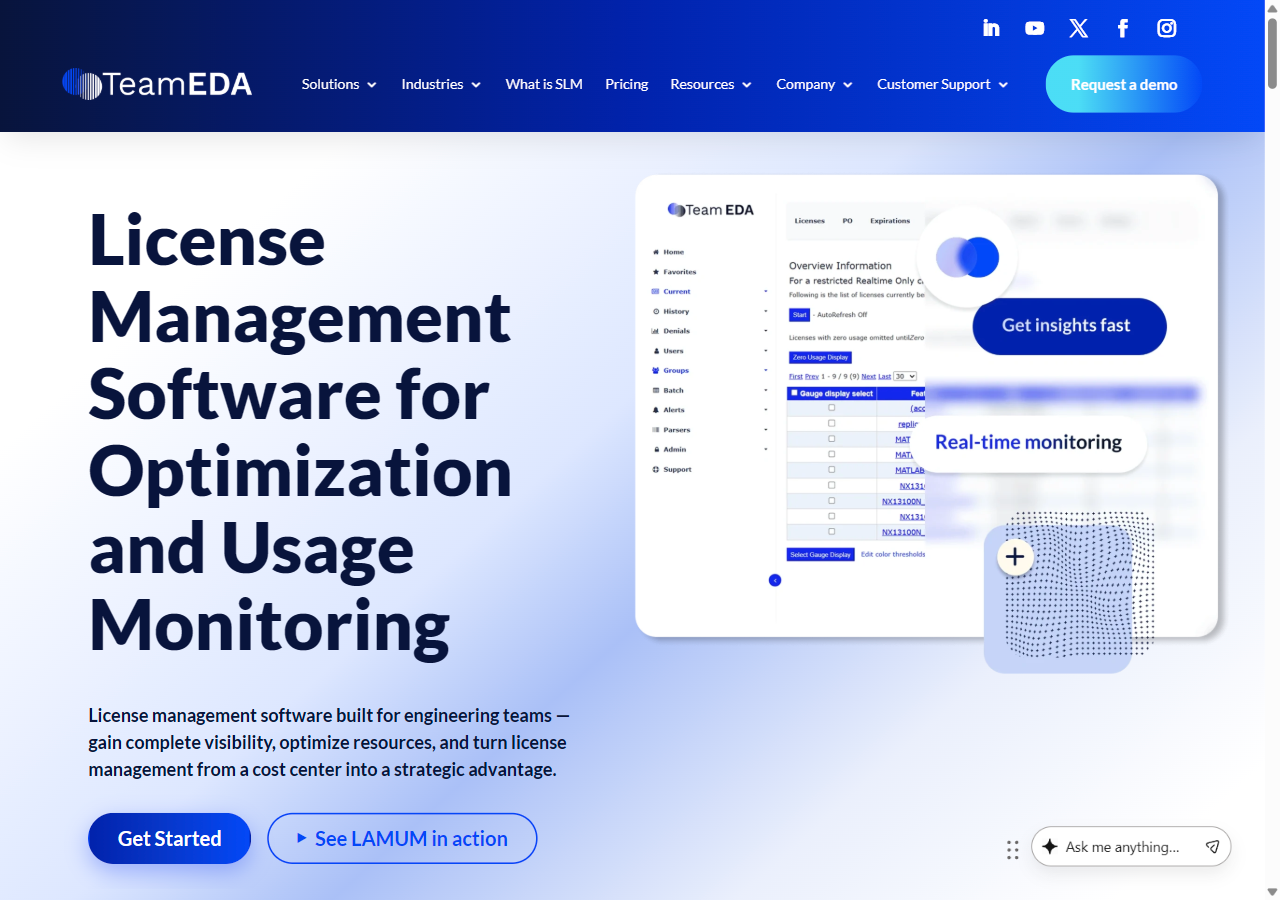
TeamEDA (LAMUM)
TeamEDA’s platform, LAMUM (License Asset Manager with Usage Monitoring), is available as LAMUM Cloud or LAMUM Pro, with Agent Monitor and Advanced Analytics as add-ons. It’s the broadest license-manager list in this comparison: FlexLM/FlexNet, RLM, DSLS, LUM, LM-X, Sentinel HASP/LDK, Sentinel RMS, Hardlock, Codemeter, Green Hills Software, Eplan License Manager, Moldex3D, MathLM, and Atlassian and Altium licensing – a longer named list than OpenLM or FNMEA publish, including several niche managers (Eplan, Hardlock, Green Hills) neither of those two name at all.
Named engineering applications include Siemens NX, PTC Creo, Dassault Systèmes CATIA, SolidWorks, Autodesk, Ansys, Cadence, and Synopsys. Features include real-time dashboards and historical trend analysis, cross-tool referencing to connect usage patterns with denial counts, idle-seat reclamation, feature-level usage tracking (which capabilities engineers use inside a bundled product), cross-timezone utilization planning for global teams, and scenario modeling for evaluating different license configurations before committing to them. On the administrative side, LAMUM offers policy recommendations for checkout durations, alerting on policy violations and extended checkouts, and quarterly health checks.
TeamEDA lists named customers across a wide industry spread – Meta, LG, Sonos, Disney, NASA, Honeywell, Hitachi, iRobot, and Whirlpool among them – spanning aerospace and defense, automotive, manufacturing, electronics and semiconductor, scientific research, energy, medical devices, AEC, and industrial automation.
Best for: organizations wanting a cloud-deployable option (LAMUM Cloud) and the broadest named license-manager coverage in this comparison, particularly estates running niche managers like Eplan, Hardlock, or Green Hills Software that the larger platforms don’t list by name.
X-Formation License Statistics
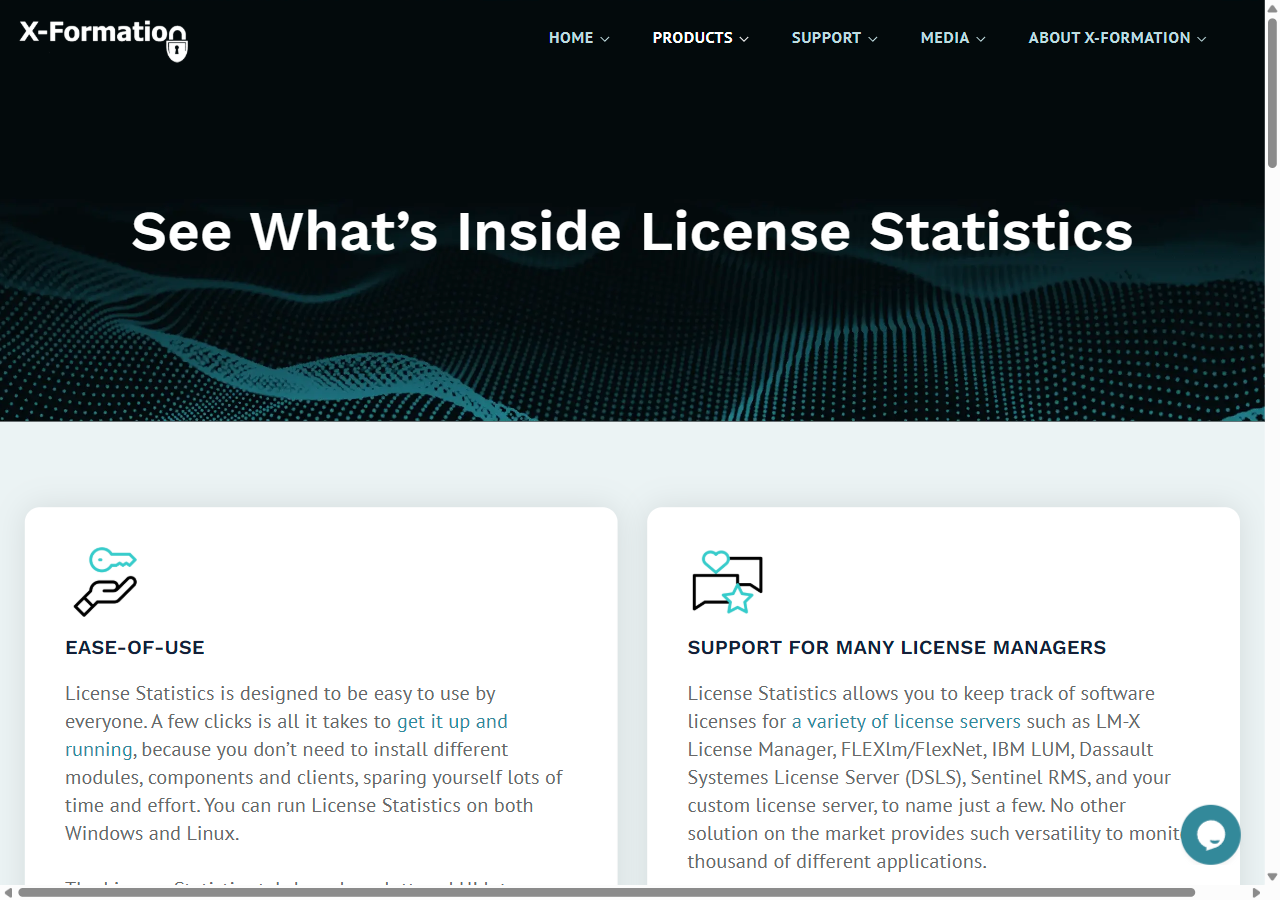
License Statistics is a browser-based dashboard for license usage across LM-X, FLEXlm/FlexNet, IBM LUM, DSLS, Sentinel RMS, and custom license servers. Its stated feature set includes real-time and historical usage reporting, per-user utilization rates, denial tracking, License Harvesting to release idle licenses automatically, and email alerts for high utilization or server downtime, with LDAP/Active Directory integration and an API for report extraction.
The interface runs entirely in-browser with no separate module to install, and the license-manager list, while shorter than TeamEDA’s or Open iT’s, covers the core set most engineering estates run: FlexLM/FlexNet, RLM-adjacent systems via custom server support, IBM LUM, DSLS, and Sentinel RMS. Unlike OpenLM, FNMEA, and TeamEDA, X-Formation’s own site doesn’t name specific engineering application vendors by product – coverage is described generically as monitoring for “thousands of different applications” running on the license managers listed above, so a prospective buyer has to verify their application list directly rather than checking it against a published table.
Best for: smaller or leaner engineering estates that want a lighter-weight, self-hosted dashboard across the core license-manager set without evaluating a broader platform’s full feature surface – a narrower tool for a narrower job, deliberately.
How the field compares
Pricing is left out of this table on purpose: none of the five publishes list prices, and each quotes based on estate size and scope.
| Tool | Idle vs. checkout distinction | License-manager coverage | Automated reclamation | Named third-party integrations | Best for |
|---|---|---|---|---|---|
| iT öffnen | Level 2 True Active Usage – endpoint-level active-vs-idle, not inferred from checkout | 90+ managers (Sentinel, FlexNet/FlexLM, RLM, DSLS, LM-X, IBM LUM, AltairLM, MathLM, OLicense, and more) | Level 3, on FlexLM, LM-X, LUM, RLM | Excel, Power BI, Tableau, SSRS · ServiceNow Store app | Visibility across every SAM scenario, industries above |
| FlexNet Manager for Engineering Applications | Vendor states idle-seat identification · reviewers cite reporting-layer (Cognos) complexity | FlexLM (primary), Reprise/RLM and Sentinel via configurator · LM-X, BetaLM on roadmap | Vendor states reclamation/reallocation workflow | Cognos Analytics | Existing Flexera/FlexNet Manager Suite customers |
| OpenLM | Real-time consumption view, historical audit logs, denial tracking | 100+ managers claimed (vendor figure) | Automated harvesting + seat reassignment (vendor-stated) | ServiceNow, Monday.com, Salesforce | Broadest self-claimed app count · wide third-party integration |
| TeamEDA (LAMUM) | Real-time + historical dashboards, cross-tool referencing | FlexLM/FlexNet, RLM, DSLS, LUM, LM-X, Sentinel HASP/LDK, Sentinel RMS, Hardlock, Codemeter, Green Hills, Eplan, Moldex3D, MathLM, Atlassian, Altium | Idle-seat reclamation (vendor-stated) | Not independently documented here | Cloud deployment · niche license-manager coverage |
| X-Formation License Statistics | Real-time + historical usage, utilization-rate reporting | LM-X, FLEXlm/FlexNet, IBM LUM, DSLS, Sentinel RMS, custom servers | License Harvesting, idle-license release (vendor-stated) | LDAP/Active Directory, API | Smaller estates wanting a lighter-weight dashboard |
Software license management for subsurface and E&P applications
Some of the most specific subsurface software estates come up again and again in this comparison: Petrel, tNavigator, Geoteric, Paleoscan, Techlog, MOVE, Cegal Blueback Suite, Norsar, and AspenTech. Coverage across that list isn’t uniform, and it’s worth being specific about where each one stands rather than implying blanket support.
| Application | Anbieter | Open iT support status |
|---|---|---|
| Sturmvogel | SLB | Natively supported – FlexNet-based, denial reporting, full Level 1/2/3 stack, 70+ individually licensable modules |
| tNavigator | RFDynamics | Natively supported – concurrent use, elapsed time, real-time monitoring, and one of 12 managers under CLIMS™ one-console administration |
| Geoteric | Geoteric | Metered in production deployments but not yet on the public supported-applications list – covered through the Generic License Utility and Generic Log Parser rather than a native integration |
| Paleoscan | Eliis | Same as Geoteric |
| Techlog | SLB | Same as Geoteric |
| MOVE | Erdöl-Experten | Same as Geoteric |
| Cegal Blueback Suite | Cegal | Same as Geoteric |
| Norsar | Norsar | Same as Geoteric |
| AspenTech (RMS) | AspenTech | Support status pending internal confirmation – not yet cleared for publication |
Every industry runs a different engineering estate
The tools above solve the same structural problem – checkout isn’t use – but what that means day to day depends on which industry’s estate you’re running.
In automotive, the pressure is regulatory as much as financial: CATIA, 3DEXPERIENCE, and DSLS-licensed pools sit inside evidence trails that audits and export-control reviews can reach into. European deployments add a second constraint: user-level usage data can trigger works-council co-determination and GDPR obligations. That’s why username pseudonymization and on-premises data residency matter there, not as a generic security checkbox.
In semiconductor and EDA, the attribution problem is structural rather than behavioral: most license consumption in a design estate – Synopsys, Cadence, Siemens EDA, Ansys, Keysight – arrives from a farm job, a virtual desktop, or a service account rather than a named person at a keyboard, so a tool that only maps checkouts to users is guessing at exactly the population that matters most.
In energy and subsurface, the problem is module hoarding: Petrel’s 70-plus individually licensable modules and a slow startup time push people toward reserving what they might need rather than what they’re about to use, and that pattern is often the largest single software cost line in the portfolio.
In engineering, manufacturing, and AEC, the estate is the most fragmented of the four – a mix of CAD, simulation, and discipline-specific tools from a long tail of vendors, where the real risk is a bundled product like Autodesk’s collections reporting as one line item when the cost driver is a handful of specific features inside it.
Where does your estate fit? If your engineering estate looks like one of these – or some mix of all four – it’s worth talking through where your gap is. Book a demo with Open iT and bring the application list. Thirty minutes is usually enough to tell you honestly whether usage data would change how you’re managing it.
Häufig gestellte Fragen
What is software license management (SLM)?
The discipline of tracking who holds a software entitlement, whether it’s actually being used, and what happens when it isn’t. For most commercial software, that’s close to inventory tracking. For engineering software licensed by feature and shared as a floating pool, it also has to measure activity, not just checkout. See Open iT’s Software License Management 101 for the full general-purpose definition, license types, and deployment models.
What are the top software license management tools for engineering applications?
Open iT, FlexNet Manager for Engineering Applications (Flexera), OpenLM, TeamEDA (LAMUM), and X-Formation License Statistics are the platforms most commonly evaluated for floating and concurrent engineering license tracking, as distinct from general enterprise SAM tools built for named-user software – with Open iT typically evaluated first for its depth of usage metering, the criterion this comparison leads with above.
What are the essential features of engineering software license metering?
Checkout and denial visibility from the license server itself, actual-usage measurement at the endpoint rather than inferred from the checkout, and automated reclamation that acts on idle time without someone closing sessions by hand. Breadth of license-manager coverage and how a vendor’s delivery and training process works matter just as much as the feature list.
Which license reporting solutions offer the best integration with engineering design software?
Each of the five platforms compared here names specific CAD and engineering vendors in its own coverage – Open iT (90+ license managers including Sentinel, FlexNet/FlexLM, RLM, DSLS), TeamEDA (Siemens NX, PTC Creo, CATIA, SolidWorks, Ansys, Cadence, Synopsys), OpenLM (Autodesk, Bentley, Siemens, Dassault Systèmes), and FNMEA (Autodesk, tiered/token models for Cadence and IBM). Ask any of them for their coverage against your specific estate rather than a general claim.
How do I automate and centralize software license management across a fragmented estate?
Automating the response means acting on idle time with reclamation rules rather than a person manually closing sessions – most platforms in this category, including Open iT, FNMEA, OpenLM, TeamEDA, and X-Formation, offer some version of automated harvesting. Centralizing means one console administering multiple license-manager types directly. Open iT’s CLIMS™ does this across 12 manager types from one console.
Is there a free software license management tool?
Not among the five compared on this page – all are commercial products, typically quoted by estate size and scope. Free and open-source options usually exist for tracking a single license manager type, not for reporting across a mixed estate, which is the harder problem engineering organizations need solved.
Does software license management cover open-source license compliance?
No – that’s a different category (software composition analysis: scanning code for GPL, MIT, or Apache-licensed components and their legal obligations). None of the tools compared on this page are built for it.
Is SaaS license management the same as engineering license management?
No. SaaS license management tracks named-user subscription seats for provisioning and renewal. Engineering license management tracks floating, concurrent entitlements shared across a pool – the model most engineering software actually uses.
What are best practices for managing floating licenses for design tools?
Track denials separately from shortages – a denial only means a request failed, not that the pool is too small. Measure idle time at the endpoint before buying more seats. Set reclamation rules that match how long a session can realistically sit open before it’s genuinely abandoned.
Where can I find reviews of software license management products used in engineering?
Gartner Peer Insights, G2, TrustRadius, and Capterra all carry reviews for tools in this category. As of this page’s 2026 research, Open iT holds 4.4 out of 5 across 77 verified reviews on Gartner Peer Insights, and FlexNet Manager for Engineering Applications holds roughly 77 reviews at a 4.1-out-of-5 average on G2.
Does this integrate with ServiceNow, SCCM, or SAP?
Open iT is one of the metering technologies behind ServiceNow’s Engineering License Management and ships a published ServiceNow Store application. OpenLM also names a direct ServiceNow integration. A native SCCM or SAP connector isn’t documented for any of the five platforms compared here.