





- Moving engineering software like 3DEXPERIENCE SOLIDWORKS to a vendor-managed cloud removes the FlexNet-style telemetry teams normally use to diagnose a denied license checkout.
- A blocked cloud license can have nine different causes — only one (real capacity exhaustion) is a purchasing problem; the other eight are administrative and fixable without new spend.
- Manually reconciling the portal, procurement records, and Microsoft Entra sign-in data to find the real cause costs hours per tenant, and repeats per account if the org runs more than one.
- Open iT’s LicenseAnalyzer collects entitlement, assignment, validity, sign-in, and usage data from SOLIDWORKS Cloud on a schedule and normalizes it against FlexNet, DSLS, and MATLAB history.
- Normalized data separates durable license shortages from administrative noise, giving procurement a measured-demand case instead of a screenshot.
Hours before a design release, several engineers cannot open the 3DEXPERIENCE SOLIDWORKS package their drawings depend on. The portal reports available subscriptions, procurement reports an active contract, and Microsoft Entra reports the accounts are active. At the same time, the FlexNet pools carrying verification and timing tools are running flat out against a tape-out date. The tape-out problem, whatever it turns out to be, is one you know how to take apart. The SOLIDWORKS one sits on infrastructure that belongs to the vendor.
A denied FlexNet checkout comes with a procedure attached. Query the server. Check the vendor daemon. Pull the debug log. Find out who holds the feature, on which host, and for how long. The evidence sits on infrastructure you control, in formats your team has been reading for a decade.
Move one application to a vendor-managed cloud platform and the procedure stops working. No daemon. No debug log. Entitlements, assignments, token ceilings and subscription end dates live in a portal owned by the vendor, and the only user-level signal you can correlate them against sits in your identity platform.
The data exists. None of it lands anywhere you can compare against a feature checkout.
The estate gets wider, not simpler
Semiconductor organizations don’t move engineering software to the cloud in one step. FlexNet keeps carrying the chip, package, PCB, verification, timing and signoff tools. DSLS keeps carrying Dassault pools. MATLAB toolboxes keep running against a customer-managed server. Then a mechanical program gets a 3DEXPERIENCE SOLIDWORKS Cloud tenant, and a fourth licensing model joins the estate with none of the telemetry the other three generate.
The estate already runs on hard questions. Which feature denied, and whether lmstat, the vendor daemon or the debug log holds the reason. How project shares get weighted when two programs want the same pool. Whether preemption should hit the license or the compute slot. How much real demand sits behind an entitlement, and how much tape-out queue time traces back to a license rather than a core. FlexNet gives up an answer to every one of them, which is what lets procurement be held to a standard: negotiate from measured demand, not last year’s peak.
The cloud tenant answers none of them.
One symptom, nine possible causes
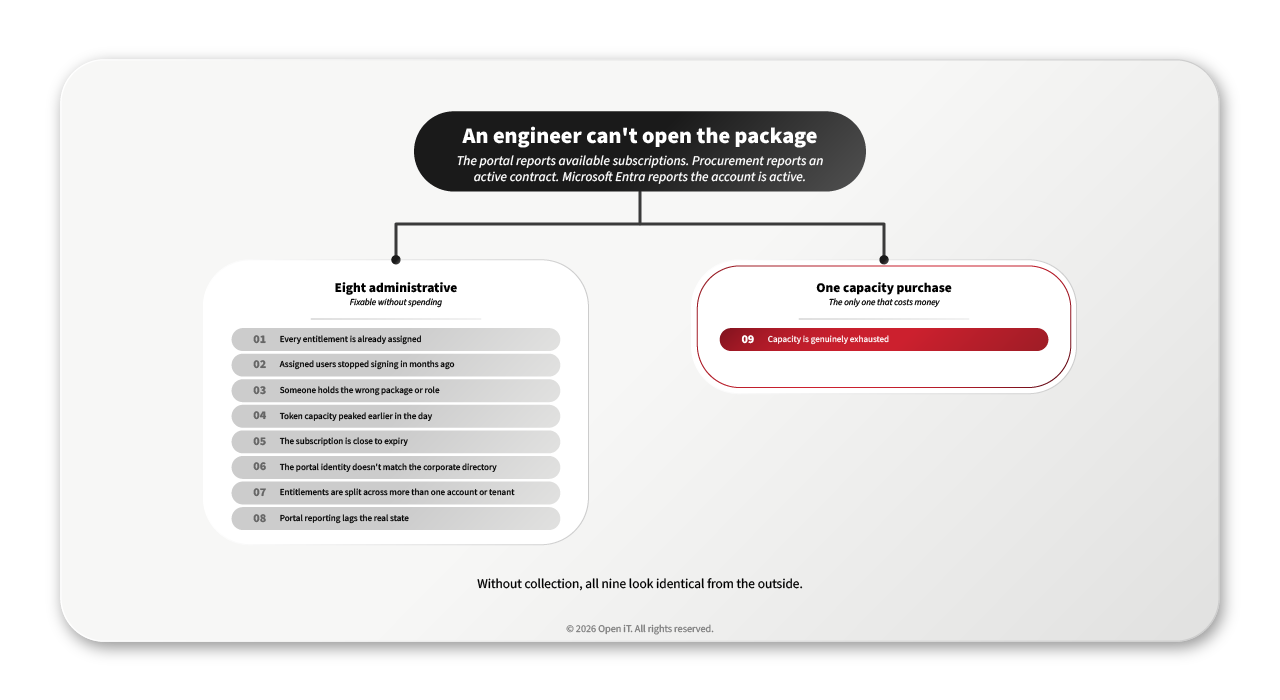
Nothing in those three systems is lying. The portal answers whether subscriptions exist, procurement answers whether they are paid for, and the directory answers whether the people are real. None of them answers the question you actually have, because any of these would produce the same symptom:
- every entitlement is already assigned
- assigned users stopped signing in months ago
- someone holds the wrong package or role
- token capacity peaked earlier in the day
- the subscription is close to expiry
- the portal identity doesn’t match the corporate directory
- entitlements are split across more than one account or tenant
- portal reporting lags the real state
- capacity is genuinely exhausted
Only the last one is a purchase. The other eight are administrative. Without collection, all nine look identical from the outside, and under milestone pressure every one of them gets treated as the ninth.
What the manual path costs
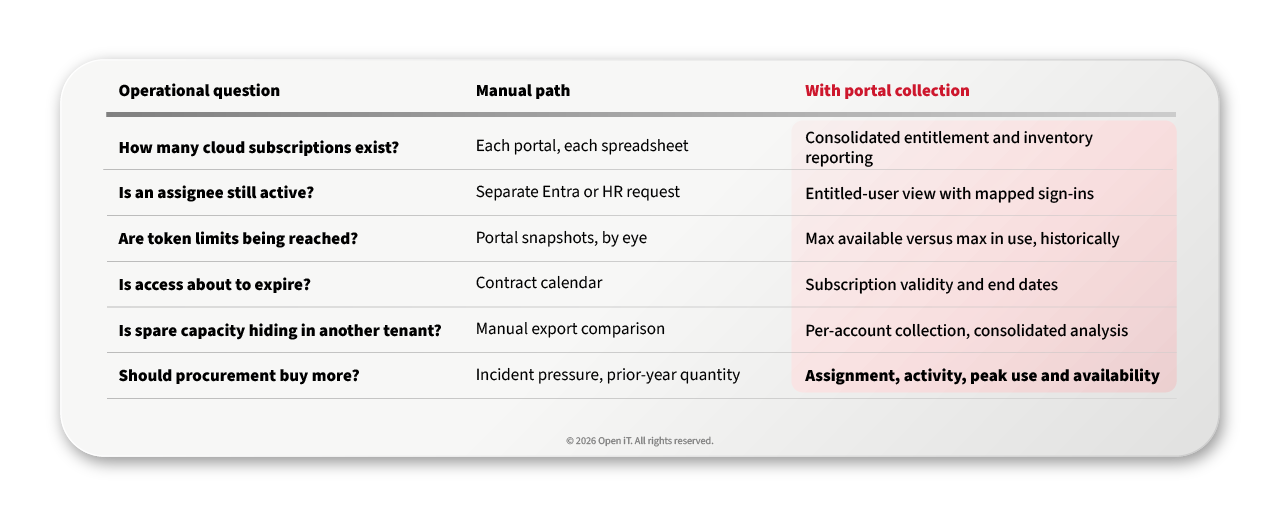
You export the portal. You request sign-in records from the identity team. You ask project administration which contractors are still active. You open the procurement sheet for quantities and end dates. Product names differ across all four sources, and some identities don’t match at all. If the organization runs more than one tenant, every step repeats per account.
Meanwhile FlexNet, DSLS and MATLAB data stay in their own utilities, logs and reports. Nothing normalizes a named-user cloud assignment against a concurrent feature checkout or a token event.
So you protect the milestone the only way you can: buy more subscriptions. Weeks later the reclaim analysis shows several of those seats belonged to people who had already left the project. Those seats don’t disappear at renewal. They become the baseline quantity, and the next negotiation runs on purchased volume plus last year’s peak, which is the input license-scheduling work exists to replace.
What a portal collector actually returns
Open iT’s LicenseAnalyzer® connects to your 3DEXPERIENCE tenant and collects on two schedules. Usage is sampled through the day, so a peak becomes part of a usage history instead of whatever the portal happens to show at the moment you look at it. Subscriptions and product assignments are pulled once a day. If the organization runs more than one SOLIDWORKS account, each one is collected and the results are analyzed together.
That gives you the categories the portal alone won’t line up:
- license type, including named-user and token models
- maximum available versus maximum in use
- subscription validity and end dates
- product assignments and inventory
- Feature Elapsed Time per User
- most recent sign-in activity for entitled users, with configurable inactivity thresholds
The sign-in view comes from configured Microsoft Entra credentials and an application-sign-in-to-vendor-license mapping. Read it for what it is: evidence that an entitled identity is still active, not proof of productive engineering work. Pair it with elapsed time before you reclaim anything.
Normalization is where it pays
Collection on its own gives you four more exports. The comparison is the point.
FlexNet polls with lmutil hourly at a five-minute sample, and parses debug logs separately into license logfile events. DSLS polls DSLicSrv on the same cadence and parses both the license-server log and the token-usage log. MATLAB polls hourly at a two-minute sample and aggregates by user, host, usergroup and hostgroup. Four collection methods, four vocabularies.
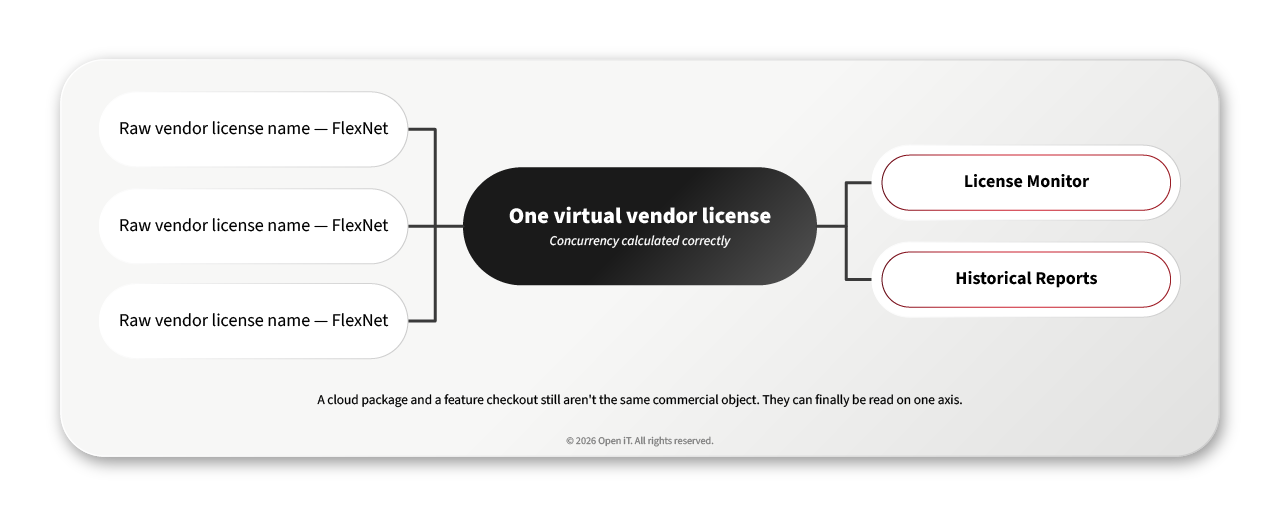
Vendor license mapping combines multiple raw vendor license names into one virtual vendor license with concurrency calculated correctly, and that virtual name shows up in License Monitor and in historical reports. A cloud package and a feature checkout still aren’t the same commercial object. They can finally be read on one axis.
The decision changes
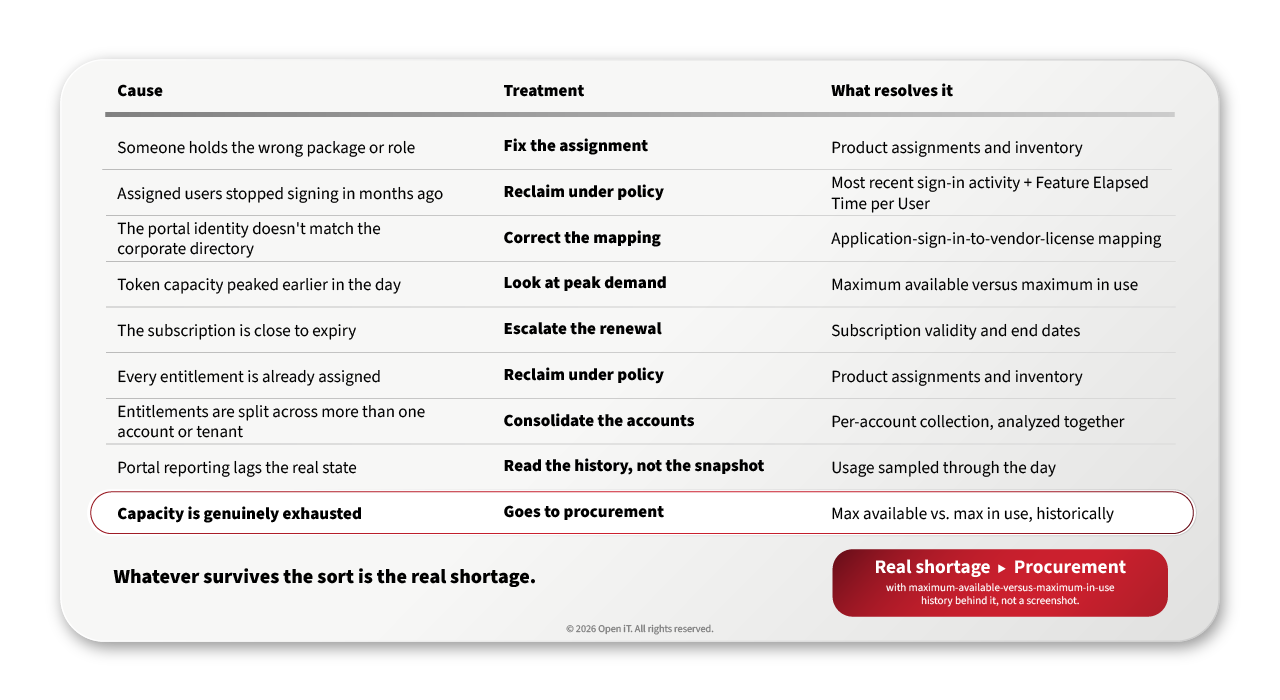
Back to the blocked engineers. With entitlement, assignment, validity, sign-in and usage in one model, the nine causes sort into groups that get different treatment. Wrong package, fix the assignment. Dormant assignee, reclaim under policy. Identity mismatch, correct the mapping. Token saturation, look at peak demand. Approaching expiry, escalate the renewal.
Whatever survives that sort is the real shortage, and it reaches procurement with maximum-available-versus-maximum-in-use history behind it instead of a screenshot.
It’s also the renewal input. Sustained concurrency, assignment counts, recent activity and subscription validity separate a durable requirement from an administrative one. One collection, two uses.
The narrow claim
Portal collection doesn’t schedule jobs, price cloud compute, or change an assignment for you. It closes one gap: the part of the estate that went dark when an application moved off a license server you control. Entitlement, assignment, validity, sign-in and usage, collected on a clock and read on the same axis as your FlexNet, DSLS and MATLAB history. That is what separates the eight administrative causes from the one that costs money, in the hour you need the answer rather than the week after.
The license server didn’t disappear. It stopped being the only place the answer lives.
The configuration steps and the full report set for SOLIDWORKS Cloud collection are published in the Open iT documentation. If you’d rather see it against your own estate, the shortest useful test is one cloud tenant and one FlexNet pool, read side by side.
Frequently Asked Questions
What is a cloud license blind spot?
It’s the visibility gap created when engineering software moves from a self-hosted license server, like FlexNet or DSLS, to a vendor-managed cloud platform. The portal, procurement, and identity systems each report their own slice of the truth, but none of them expose the feature-level checkout data teams used to get from a license daemon and debug log.
Why doesn't 3DEXPERIENCE SOLIDWORKS Cloud provide the same visibility as FlexNet?
FlexNet, DSLS, and MATLAB license servers run on infrastructure the organization controls, which is why they can be queried and logged in detail. A SOLIDWORKS Cloud tenant runs on Dassault-owned infrastructure, so entitlements, assignments, token ceilings, and subscription dates live in a portal with no daemon or debug log to query directly.
If a SOLIDWORKS Cloud license shows as denied but subscriptions look available, what's actually wrong?
There are nine possible causes, and only one, genuine capacity exhaustion, is a purchasing problem. The other eight are administrative: assignment errors, dormant users still holding entitlements, identity mismatches between the portal and the corporate directory, token saturation earlier in the day, near-expiry subscriptions, split entitlements across tenants, or stale portal reporting.
What does Open iT's LicenseAnalyzer collect from a SOLIDWORKS Cloud tenant?
It collects license type (named-user and token models), maximum available versus maximum in use, subscription validity and end dates, product assignments and inventory, Feature Elapsed Time per user, and most recent sign-in activity for entitled users, sampled through the day for usage and pulled daily for subscriptions and assignments, across every tenant if the organization runs more than one.
How does this change what procurement sees at renewal?
Instead of a screenshot or last year’s peak usage, procurement gets sustained concurrency, assignment counts, recent activity, and subscription validity in one normalized view, separating a durable license shortage from an administrative issue that doesn’t need new spend.